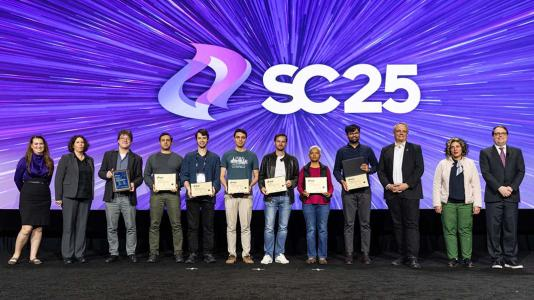
Congratulations to Chameleon users Faveo Hoerold, Ivan R. Ivanov, Akash Dhruv, William S. Moses, Anshu Dubey, Mohamed Wahib, and Jens Domke — researchers from Argonne National Laboratory, ETH Zürich, RIKEN Center for Computational Science, Institute of Science Tokyo, and the University of Illinois Urbana-Champaign — on winning the SC25 Best Reproducibility Advancement Award for their paper "RAPTOR: Practical Numerical Profiling of Scientific Applications." RAPTOR is a numerical profiling tool that helps scientists understand how their software behaves under reduced floating-point precision, enabling informed decisions about where lower-precision computation is safe — a critical challenge as AI-driven hardware pushes HPC toward half and quarter precision. The team made their artifact fully reproducible on Chameleon Cloud, providing pre-configured appliances that allow any researcher to replicate their results without the burden of from-scratch environment setup.
If you would like to reproduce this artifact, you can do so using the authors' original artifacts uploaded on Trovi (try requesting a Chameleon DayPass if you do not have an existing Chameleon project):
- Full artifact: https://trovi.chameleoncloud.org/dashboard/artifacts/c2ebe3cc-b1dd-4ca4-a439-e2833e8a94a5
- Partial artifact (faster to reproduce): https://trovi.chameleoncloud.org/dashboard/artifacts/e62a705b-d0b6-47a0-8ce7-c75aef1e001e
The SC Best Reproducibility Advancement Award recognizes outstanding efforts in improving transparency and reproducibility in high-performance computing research. It is given to the paper or research artifact that most significantly advances the state of the art in reproducibility, rewarding not just good science, but science that others can actually verify and build on. "Reproducibility is a cornerstone of scientific computing," said Akash Dhruv, an assistant computational scientist at Argonne. "We hope that our efforts inspire fellow scientists and researchers to keep pushing the envelope toward making their work accessible and reproducible, allowing traceability and establishing trust in science, especially in this new age of AI."
This marks the second consecutive year a Chameleon user has taken home this award. At SC24, the KaMPIng team won for "KaMPIng: Flexible and (Near) Zero-Overhead C++ Bindings for MPI," a C++ library that dramatically simplifies MPI programming while preserving near-zero performance overhead — reducing hundreds of lines of distributed computing boilerplate to a handful of expressive calls. Like the RAPTOR team, the KaMPIng authors relied on Chameleon Cloud to make their artifact evaluation accessible and reproducible, and if you would like to give it a whirl, look here.
Back-to-back wins by Chameleon users reflect the platform's role not just as a testbed for computation, but as infrastructure that makes rigorous, reproducible HPC research genuinely achievable.